Translate

Sunday, 15 April 2012

PICOS DE EUROPA (Fuente De) Cantabria.

We drove from the Embalse del Ebro towards Santander on the N623, which was a very interesting road, with the longest and steepest descent, from 1100mts, straight to the bottom. At the top it was very bleak, snow poles at every 3mts, wind whistling about, they must get so much snow here. With our brakes red hot, we were relieved to get to the bottom and there we passed through near tropical gardens, with palm trees, what a difference! The Parque de Cabarceno is to be our night stop as we head for the coast and we arrive in dense fog and rain, so we sit and watch wet ducks on the lake!


What a shock in the morning! Have we woken in Africa? Elephants and Antelope! No, we just had not seen what was in the Parque last night, as the weather was so bad.


As we drive to the coast, we can look back towards the mountains where we have been. Santona, is our destination, a nice seaside town, with a lovely beach and good marshes for birding. The sun is shining and we walked out on the Marisma, where Mike photographed the Gadwell below.


Tufted Ducks over wintering.


And this Little Egret in  breeding plumage.


We will return here to further explore the marshes.

Now we head for the Picos, taking a very picturesque route through the gorge, with huge limestone cliffs all around us. This is a very winding and in places, narrow, road (N612) through the tourist town of Potes and upwards. The scenery was stunning and we make our night stop high up at Santo Toribio de Liebana, on the Monestery car park, where they allow overnight parking.


Some of the views around us.


Surrounded by snow covered peaks, it seems as though we are at the top of the world and all alone.


We wake to a beautiful sunrise and blue sky, wisps of clouds passing between the peaks.


Full of anticipation, we drive to the Fuente De, to ascend the highest peaks, arriving at the cable car station, where the cable car seems very small and the ascent very high.... gulp!


Looking down from our cable car.........!


Through the cloud to the highest peaks.


We arrive at the top and the snow is all around and deep, no chance of walking far, as it is also very compacted and slippery, but the view, it just takes your breath away.


There are some funny birds up there in the snow!!
and some lovely, friendly Alpine Choughs too.


We are so Choughed with our day!  

 What a memorable experience the Picos is, not only the beautiful drive through the gorge, but the
magnificent Fuente De itself.


Saturday, 14 April 2012

LA RIOJA & CASTILLA-LEON

The smallest region of Spain is not named after a grape variety but one of the tributaries to the river Ebro (the Rio Oja) It is a very beautiful region, full of rolling vistas and vineyards growing the famous Rioja grapes.


We followed a road (LR113) through the Seirra De La Demanda, along side the Rio Najerilla, very picturesque is was. The narrow winding road finally became a track, where horses and cattle with bells around their necks roamed free. We bumped onwards through the gorge!


There we came across the submerged town of Mansilla de la Seirra in the flooded valley. Six Hundred souls lived here at the turn of the century, then permission to make a dam was given in 1935. The civil war started in 1936 and it took 25 years to complete, leaving just 100 people to bid farewell to their town when the waters closed over it!


The ruins are very eerie poking up through the waters. In the foreground you will see a big house, half standing, which was a staging post for the Grandee of Castille in centuries past. For me this photograph is amazing, it looks like  a Surrealist painting! (Mike has a Dali Moment!)


Two skeletal trees stranded in the basin of the embalse.


In the hedgerow Mike photographed some lovely Rock Buntings.

As it became late and the sky darkened with a threatening storm, we sort a stop for the night, eventually winding up to over 3,500ft at the Puerto Manquillo.


That evening a huge thunderstorm passed through the gorge below us, Mike photographed, I quaked!!


Surviving the night, we were so pleased to be visited by these Crossbills pecking all around.


Male Crossbill.


Female Crossbill.

Our next photo stop was the village of Orbaneja del Castillo, (off the N623 Burgos to Santander Road)
approached by a narrow road, with rocks like teeth towering above, quite magnificent. Linda stood in the road for you to give perspective.


Waterfalls cascade down through the village from springs that feed the great Ebro river.


Little narrow streets wind through this pretty village, steeped in history, but be warned, it is a huge destination for Spanish day trippers ( avoid weekends)


Travelling onwards we arrive at the Embalse del Ebro, where we hope to spend the night. The scenery is stunning, with a backdrop of snow capped mountains, little villages clustered below.


Although we came here to see the Ferruginous Duck (totally unsuccessful) we had a beautiful sunset!! 


Friday, 13 April 2012

FROM FRANCE INTO SPAIN (Navarre)

Before leaving France, we stopped at the reserve des Barthes, on the flood planes of the river Ardour near Bayonne. A hidden place of lakes, visited by many wading birds and hundreds of Cranes passing through on migration. Here from the hide, Mike photographed these Spoonbills going into breeding colours.


Also at this hide we watched two Greater Spotted Eagles, one a juvenile that we managed to photograph, although at great distance. It was defending its catch of a huge fish from marauding crows and a female Marsh Harrier. We watched it for about and hour, jumping and threatening the pests trying to steal its dinner. 


From des Barthes, we crossed into Spain, calling in at one of our favourite birding sites, Laguna de Pitilas, near Olite. It was blowing so hard that we witnessed something that we had only heard about!
Hundreds and hundreds of Cranes, all trying to cross the Pyrenees, but because of the high winds, unable to go further. Wave upon wave of them landed on the water margins. It was just like a Crane Traffic Jam!


On and on they came in, legs and wings dangling, trying to find a parking spot. They will wait it out, until the wind drops and they can continue northwards on their journey.


On to the Barenas Reales, this amazing semi desert landscape in Navarre. A region of arid planes, ravines and huge rock structures. It is possible to walk, cycle or drive through some of this area. Below is the road we took and very bumpy and dusty it was!


The Bardenas is one of Europe's biggest deserts, covering some 41,000 hectares, mostly unpopulated, but there remain some deserted ruins that were once peoples homes. They look quite cosy! 
No neighbours either!


It is hot in summer here and cold in winter, at most times very dry, except when flash floods cause instant rivers that then dry out, causing the strange shapes below.


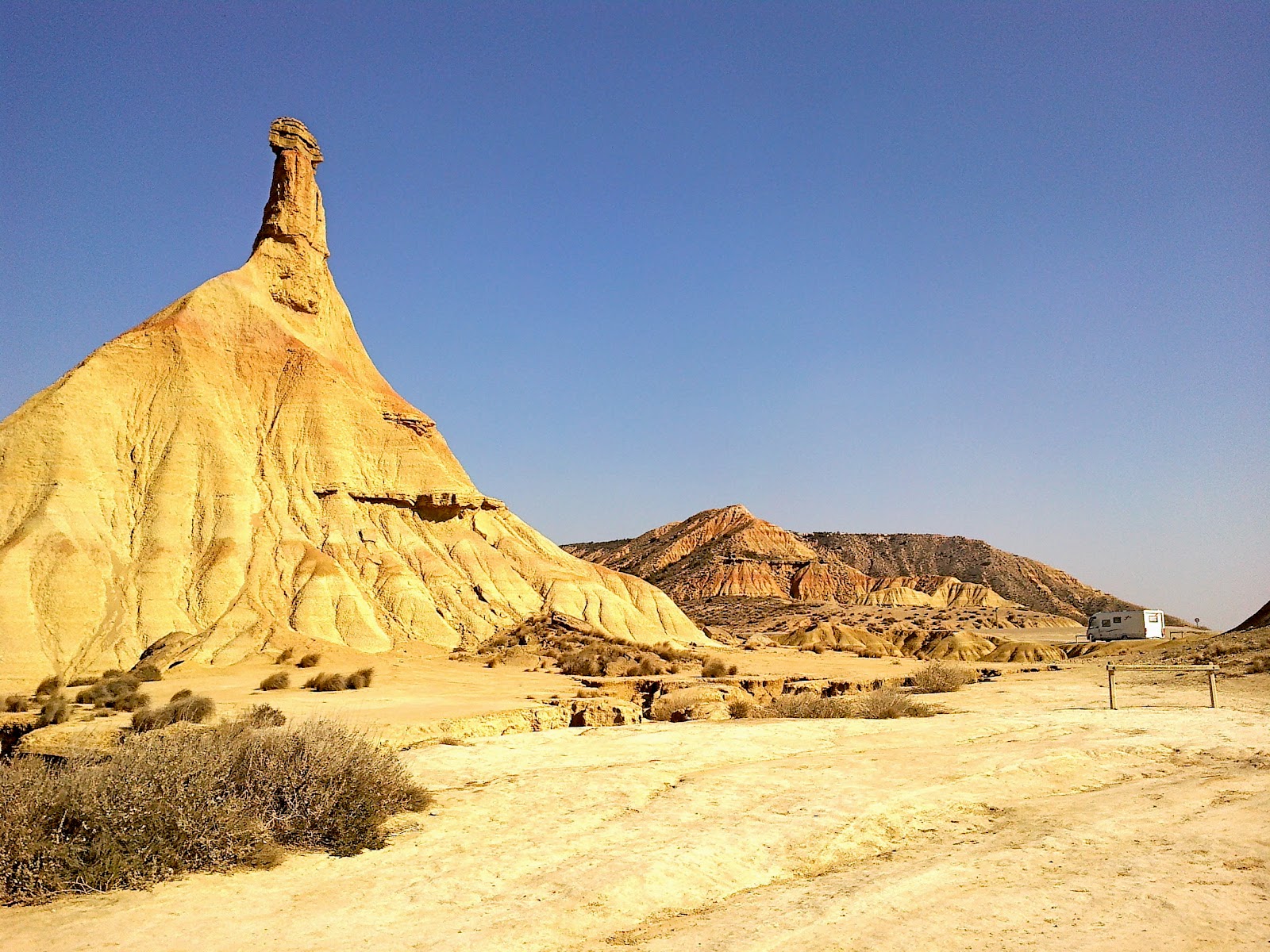
The Bardenas is divided into three large areas - El Plano, La Negra and La Blanca, where we photographed below this amazing tower of rock, the Cabezo de Castildetierra.


In the photograph below you can see the Cabezo and in the background our camper, which it dwarfed!


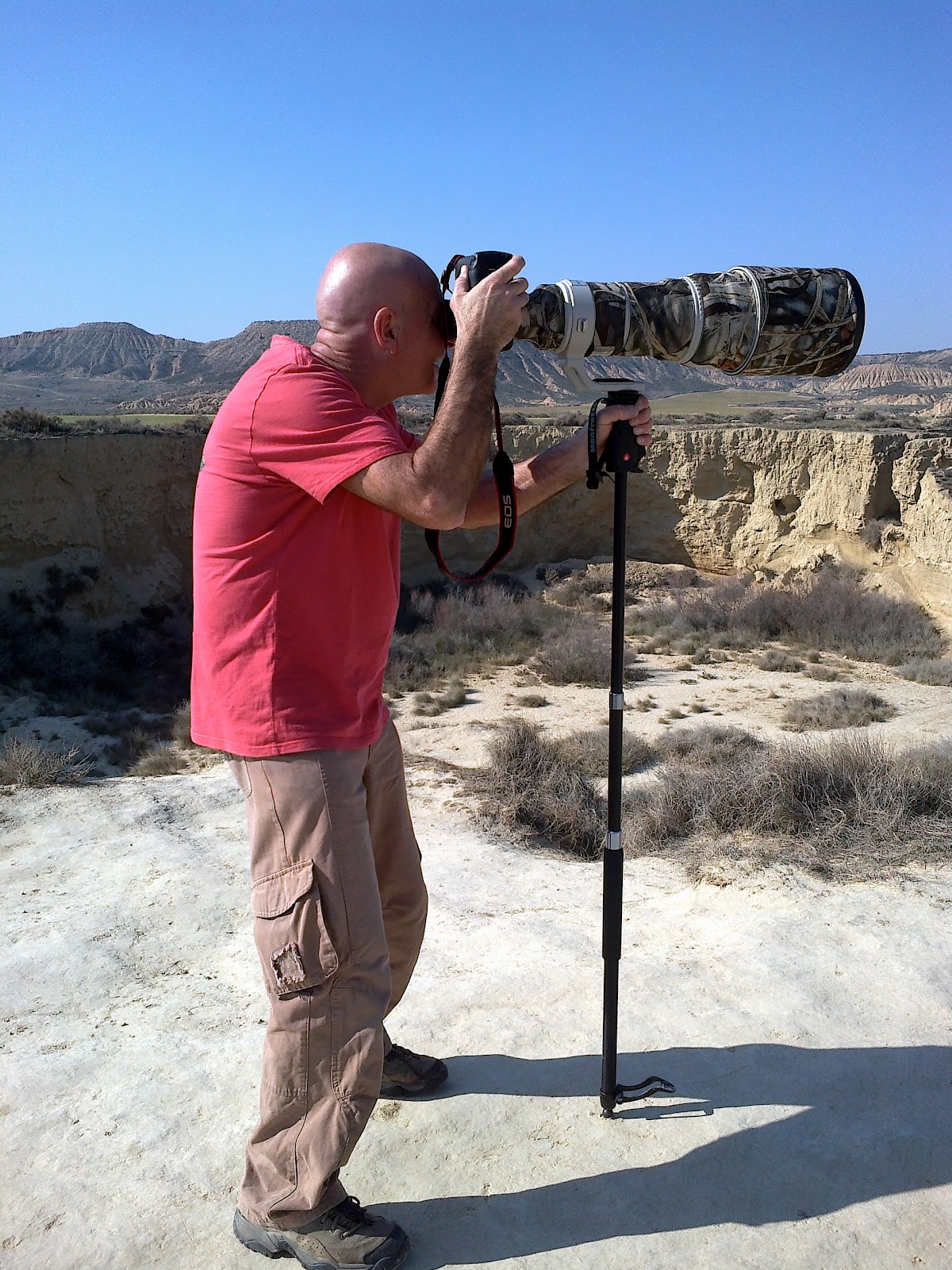
Although he would prefer to be behind the camera, I took this photograph of the man behind the lens, and what a lens it is. Mike and his baby!


So on with our adventures and travels, come with us!

Thursday, 1 March 2012

RESERVE NATIONALE D'ARJUZANX (Foret de Landes)

This is really something special! We were so very fortunate to have the weather conditions we had, this is special! 
We drove from Captieux to the reserve at Arjuzanx, forbidden access! and were lucky enough to bump into Xavier, senior reserve warden, who seemed to understand our following of the Cranes, and all the places we have been thus far to see them. He arranged a rendezvous for the following morning at 7am, to go with him and Nathalie to a special hide deep in the reserve.
The Cranes come to this area to roost for the night from all the surrounding areas and numbers may be swelled by the migrators coming from Spain and Africa. In recent years, many Cranes have not migrated further south but stayed here. During the winter here they counted 20,000 Cranes in the Landes. 
Alarm call!! and off we go, to meet up at the information centre in freezing fog! We go with our guides in one of their vehicles to the hide, situated high above the Lac de Grue.
We climb higher and higher up the observation hide in dense fog.... then dawn breaks around us, and we see the most spectacular sunrise ever, over drifting fog, the trees thrusting through the swirling mist! 


The most breathtaking sunrise ever, breaking over low mist, with trees in stark silhouette.


 We can hear the Cranes calling, but cannot see them.


The mist is all around us shrouding all..... and then....


We see them, rising out of the mist, calling, like specters all around us, some close to, some still hidden from view.


This, was for us, the most dramatic, the most mystical moment to experience!


The sun is now coming up fully and catches the tops of the trees.


Now the Cranes are picking up the light of the sunrise.


   As the Cranes pass on their journey, we watch in awe as the last ones pass over the rising sun.


 We would like to thank Xavier, Nathalie and all the wonderful people at the
Reserve nationale d'Arjuzanx.

http://www.reserve-arjuzanx.fr

We wish the Cranes safe passage north and look forward to their return!